Connect the documents
See how information in one supporting document relates to another.
DOKIMASIA / δοκιμασία
Doksima
Examine before you conclude.
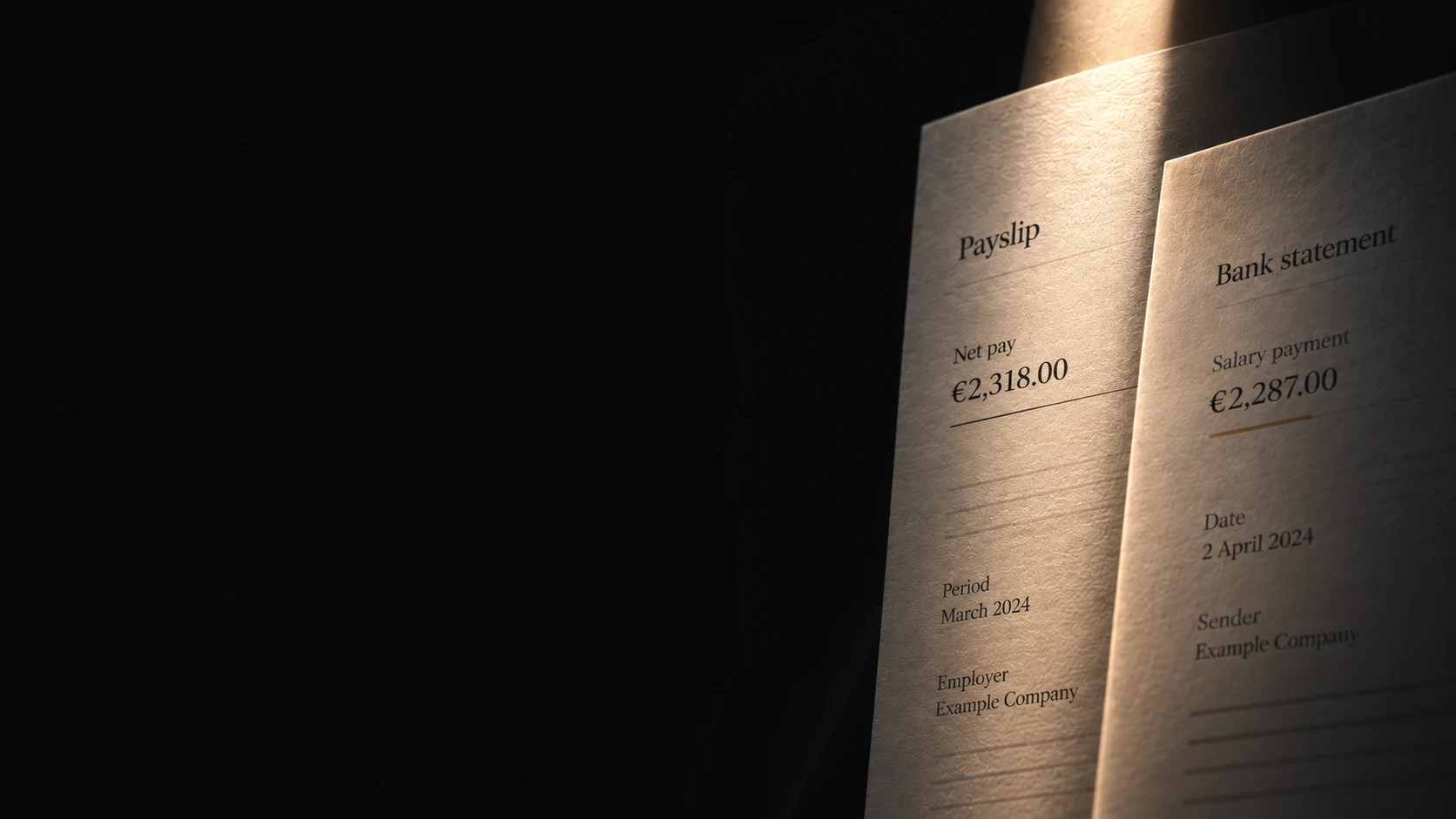
DOKSIMA · DOCUMENT VERIFICATION
Doksima compares the documents in your applications and highlights inconsistencies to investigate. Every finding is explained and linked to its source. The decision stays yours.
Payslips · Bank statements · French tax notices
Early-stage prototype for brokers · French documents
Examine before you conclude.
THE PRODUCT, IN PRACTICE
One workspace to track applications, inspect findings and organise the review. Document-check results and human review progress remain separate.
See how information in one supporting document relates to another.
Separate contradictions, indicators and points that need a better source.
Technical findings inform your review. They do not replace your decision.
AN ORGANISED REVIEW
The review queue separates check results from your team’s progress. A finding to investigate is not a decision made on your behalf.
Prototype screenshots with demonstration data. The current application and source documents are in French. This is a product walkthrough, not live document analysis.
Our name draws on dokimasia, the Greek idea of examination.
Understand before you conclude.
Chapter I
False positives
A re-exported, scanned or reissued document may show legitimate differences. Doksima distinguishes observations to review from contradictions established within the scope of its checks.
01
Return to the excerpt and page that contain the reviewed information.
02
Distinguish an uncertain reading, an indicator and a verified contradiction.
03
The analyst decides what happens next. The prototype does not promise a zero error rate.
Chapter II
The promise
The prototype distinguishes an established contradiction, a point to review and an insufficient reading. These four principles guide the review without promising a zero error rate.
The main result is a documented conclusion, not a probability of fraud. Coverage indicators remain separate.
Each check says what it observed—and what it cannot establish. You know exactly where the evidence stops.
An insufficient reading is labelled as such. If the document prevents verification, a better source may be needed. A service failure remains an internal incident.
Findings are linked to their sources, checks and versions. Reproducing a review also requires retaining the settings and reference data used.
Chapter III
Four verdicts
No scale, no quantified grey area. Every verdict has a fixed definition, sample wording and a limit stated plainly.
A material contradiction is established within the scope of the check, using readable data. It is identified and located.
Sample wording in the report
« The stated total does not match the sum of its line items. »
What this check does not say
A calculation error does not prove deliberate falsification. This check establishes neither author nor intent.
A material contradiction is established within the scope of the check, using readable data. It is identified and located.
Sample wording in the report
« The stated total does not match the sum of its line items. »
What this check does not say
A calculation error does not prove deliberate falsification. This check establishes neither author nor intent.
The required content checks conclude that the document is consistent, with sufficient coverage within the reviewed scope.
Sample wording in the report
« Dates, amounts and issuer match from one page to the next. »
What this check does not say
This check does not say the document is authentic at source. It says it is internally consistent.
An unusual element has been observed. It is not enough to prove falsification. We state it plainly.
Sample wording in the report
« The file creation date is later than the document issue date. »
What this check does not say
This check does not say the applicant lied. A document reissued by its issuer may produce this finding.
The supplied copy does not allow a conclusion. We do not guess. We request the original document.
Sample wording in the report
« Photograph of a screen. Structural checks cannot be applied. »
What this check does not say
This verdict says nothing about the applicant's honesty. It says this copy is not enough.
Chapter IV
Checks
Each check returns a conclusion, a signal or a justified unavailability. Its explanation specifies what was examined and what remains beyond its scope.
Example checks
Illustrative examples. Applicable checks depend on the document type, its readability and available sources.
“One question, one conclusion, one limit.”
What it finds
The stated total does, or does not, match the sum of its line items.
What it does not say
Where the amounts come from.
What it finds
Readable pay and deduction entries allow gross and net calculation to be checked.
What it does not say
That the salary was paid.
What it finds
One page’s closing balance is the next page’s opening balance.
What it does not say
That this is the holder’s only account.
What it finds
Document dates follow one another and are possible.
What it does not say
That the transaction actually took place that day.
What it finds
Metadata are compared with visible dates when available; an honest reissue remains possible.
What it does not say
Who created the file.
What it finds
Readable identifiers are checked; external verification depends on available references.
What it does not say
That the issuer produced this specific document.
What it finds
Information covered by the check is sought; this is not a complete regulatory audit.
What it does not say
That its content is accurate.
What it finds
Character or layout breaks may be flagged for review.
What it does not say
That an irregularity is deliberate.
What it finds
Accessible reissue traces may be noted; their absence does not prove no modification occurred.
What it does not say
Who modified it, or why.
What it finds
Name, address and amounts match across documents in the same file.
What it does not say
That the file is complete.
Chapter V
The independent channel
A consistent document does not, by itself, prove who issued it. Depending on the file, confirmation from an authorised source may complete the review.
In the document
Dates, amounts and references can be compared when readable. The result specifies which checks were actually performed.
At source
The analyst may contact the issuer through a verified, authorised channel. This remains distinct from checking the document; Doksima does not carry it out automatically.
Know what the document allows you to conclude. And what it leaves open.
Chapter VI
The report
A report brings together the checks, sources and review limits. The example below illustrates how to read it; it is neither a result on a real document nor a legal guarantee.
The file creation date is later than the document issue date.
That the applicant lied. A document reissued by its issuer can produce this finding.
Consider whether confirmation from the issuer through an authorised channel can clarify this point.
The example shows a date and time to place the review in context. This is not a certified timestamp.
The example has a reference number to identify the report and link it to the application reviewed.
To compare two reviews, retain the documents, checks, versions and settings. The result can change if any of these change.
Written for compliance officers, branch managers and lawyers to read directly, without technical jargon.
Who it is for
Before approval, not after. A verdict for each document, a sentence for each conclusion, and a list of documents to obtain through another channel.
An honest applicant should not have to defend against an unsupported accusation. Get a clear report that can be shared with the landlord.
The aim: a dated report with sources and explicit review limits, making it easier for a third party to understand.
First pilots
We are preparing initial pilots with brokers and financial teams. The aim is to measure the time needed to understand a file and the back-and-forth a better documented review may avoid.
01
02
03
Demo
See how a review links read information, documents to examine and the sources behind every conclusion.
Let’s talk about your review
Start a conversation.
Tell us about your team and how you review applications. Together, we will identify what to explore in a demonstration.
Email Billel ↗billel@lumelia.io